
Tower maintenance, before it becomes tower repair.
Towers don't fail overnight. They fail one loose bolt, one fatigued guy wire, one corroded connection at a time — until a windstorm finds the weakest link. Maintenance is finding that link first.
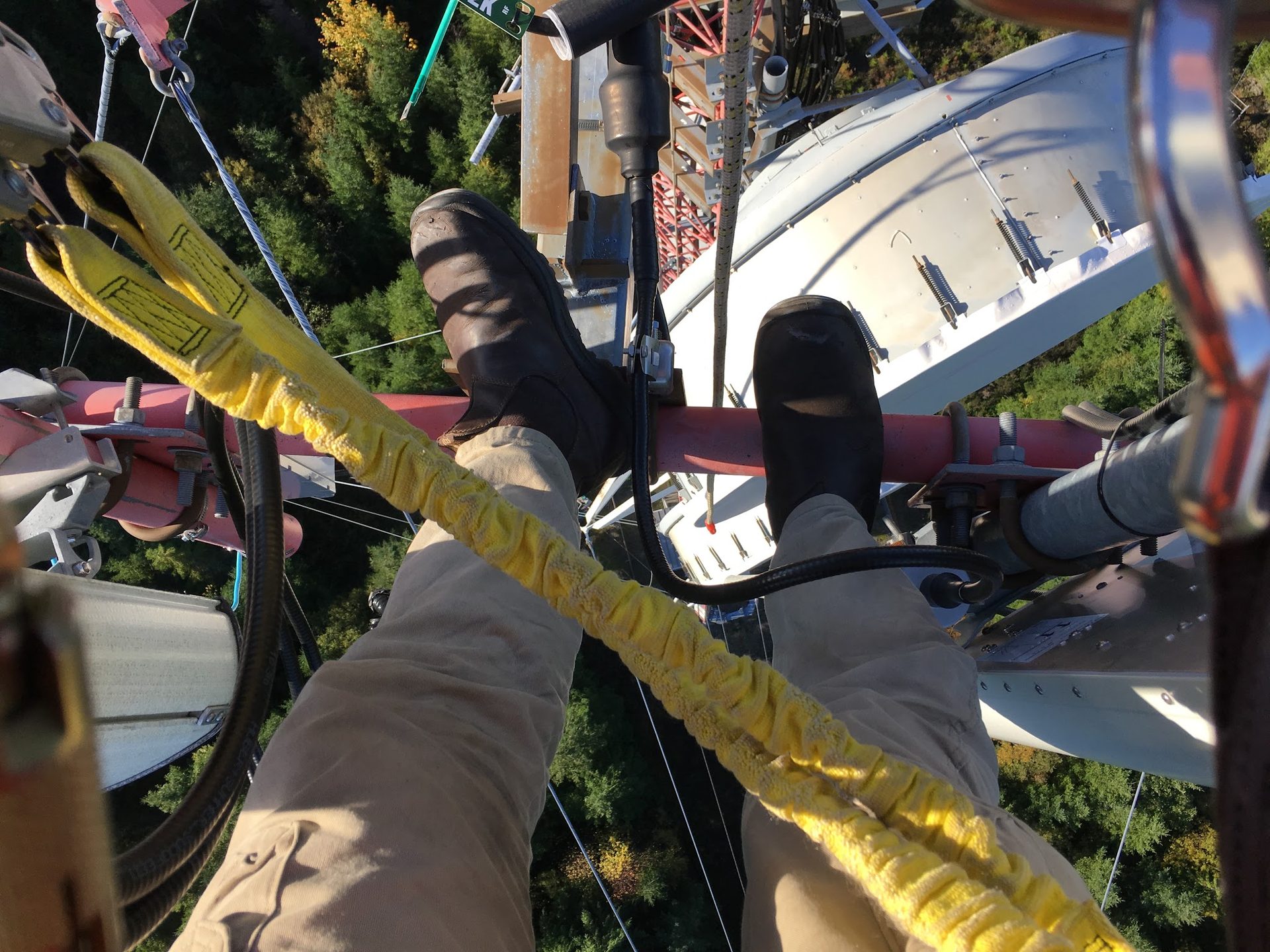
What we maintain
Guyed towers, self-supporting towers, monopoles and rooftop structures — carrier sites, WISP sites, private repeaters, club repeaters, anything with steel in the air and RF on it. If your structure carries antennas that matter to you, it belongs on a maintenance schedule.
Salt air is the local accelerant. Everything on the coast corrodes faster than it does inland — hardware, grounding systems, feedline connectors, the works. A maintenance plan written for Ontario will miss what the Pacific eats. Ours is written for where you actually live.
What's included in a maintenance visit
Structural inspection. Every accessible connection, bolt, weld and member checked — with attention to the places that hide damage: base plates, anchor heads, climb ladders, platforms.
Guy-wire tensioning. Guys stretch, anchors settle, temperatures cycle. We check tension against spec and re-tension to bring the structure back into plumb. An out-of-plumb tower is a tired tower.
Antenna and feedline swaps. Aging antennas, waterlogged feedlines and UV-cracked jumpers are the most common performance killers we find. We replace what's failing and re-test the line.
Grounding checks. Grounding degrades — bonds corrode, theft happens, upgrades bypass the original system. We verify continuity and bond integrity, because lightning doesn't negotiate.
Salt-air corrosion control. Cleaning, treatment and protection of vulnerable hardware, with a record of what was treated and when, so the next visit knows exactly where to look.
Recurring contracts vs. one-off service
One-off visits fix what's wrong today. Recurring contracts — annual or semi-annual, depending on the structure and the exposure — keep a running record of your tower's condition over time. Trends beat snapshots: a guy wire that's lost 5% of its tension twice in a row is telling you something a single visit can't.
Contract clients get priority scheduling after storms. When the wind does its worst, the phone rings off the hook — contract holders get answered first.
Field note
After the big December blow a few years back, my phone rang for a week straight. The contract sites got same-week visits. Everyone else joined the queue. That's the whole sales pitch for a maintenance contract — priority when it matters, not a discount when it doesn't.
Why it matters financially
A maintenance visit costs a fraction of an emergency repair. An emergency climb in winter, after a failure, with a structure in unknown condition, costs a multiple of a scheduled visit — and that's before you count the downtime. If your tower carries revenue — a WISP's subscribers, a lodge's bookings, an industrial site's telemetry — downtime is the expensive part.
We've mapped 2,488 licensed cellular sites on Vancouver Island — the dataset behind our survey work — and a licence doesn't mean there's a tower. Some of those records are sites never built or long gone. We bring the same honesty to your structure: a written condition report, photos, and clear priorities — what's urgent, what can wait, what's fine.
Commercial coverage is the whole confirmed region: all of Vancouver Island, the Southern Gulf Islands, Sunshine Coast, Texada and the Discovery Islands, including boat-access west coast sites. See the Vancouver Island maintenance page for local detail, plus Campbell River and Nanaimo — or start with a new build if the structure doesn't exist yet.
How does salt air attack a coastal tower?
Salt air accelerates corrosion on steel, guy wires and hardware — which is why coastal structures get inspected annually at minimum, semi-annually if the site is high-exposure or carries critical load. Every maintenance visit includes corrosion control, tensioning where needed, and a written condition report with clear priorities.
Common questions
How often should a tower be inspected?
For coastal structures: annually at minimum, semi-annually if the site is high-exposure or carries critical load. After any major windstorm, an inspection is cheap insurance regardless of the schedule.
What are the warning signs a tower needs attention?
Visible rust streaks, loose or missing hardware, guy wires that look slack or vibrate oddly in wind, antennas that have drifted off heading, feedline with cracked jackets, and — the big one — a structure you can't remember the last inspection date of. That last one means it's overdue.
Do you work on towers you didn't build?
Yes — most of our maintenance work is on other builders' structures. The first visit includes a full condition assessment so we know exactly what we're dealing with, and so do you.
Can you service club or amateur repeater sites?
Yes. Repeater sites are often maintained on hope and volunteer weekends. A scheduled professional visit — inspection, tensioning, grounding check — is the cheapest reliability upgrade a repeater site can buy.
What does a maintenance contract cost?
It depends on the structure type, height, access and exposure — an accessible 20-metre self-support is a different job than a remote guyed tower you reach by quad. Contact us with photos and location and we'll quote it honestly. We don't do mystery pricing.
When was your tower last inspected?
If you can't answer that, it's overdue. Get a condition assessment with photos and a prioritized repair list — then decide what to fix first.